
PRINT SHOP ERP, POS & OPERATIONS
Srijaya ERP System
Jul 2026
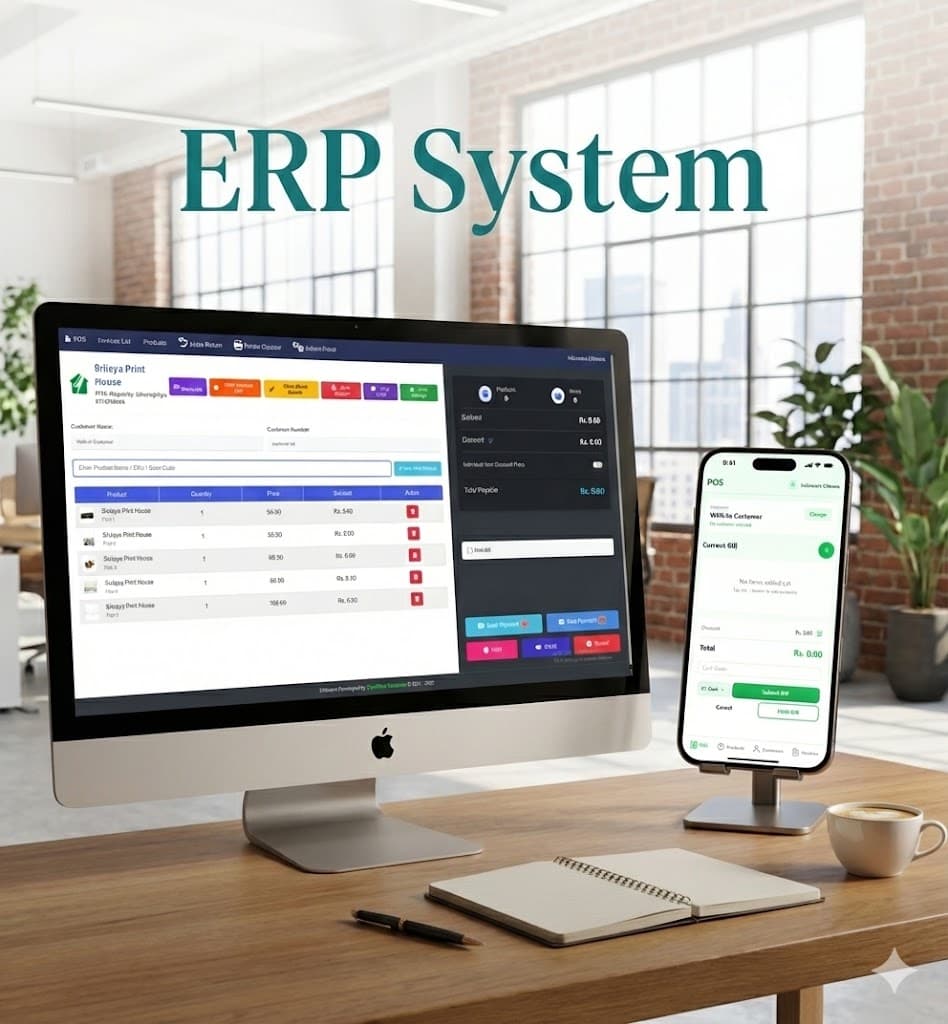
Production ERP/POS for a print and copy business: checkout, invoices, quotations, inventory, procurement/GRN, suppliers, finance, attendance, payroll, printer-meter workflows, and PayHere payments.
Technologies
Case study
Srijaya ERP System case study
Overview
Srijaya ERP is the production system I have run for a print and copy business in Colombo since 2021. Staff use it daily — it is not a tutorial schema. Checkout, invoices, quotations, custom print jobs, inventory, procurement (GRN), suppliers, finance, attendance, payroll, and reporting all live in one place. Print-specific work includes monotonic printer-meter readings, machine rent and cost tracking, deposits, and paper stock that converts packets to sheets.
The public storefront is srijaya.lk; operations sit on the POS host. I wrote about an earlier slice of this system in 2024. The product kept growing: JWT APIs, PayHere, thermal receipts, and React/Vite islands inside the PHP shell.
Problem
A print shop is retail POS, a job shop, and a machine-rental business at once. Spreadsheets and generic POS tools miss meter-based rent, ESC/POS receipts, and paper that is not a single SKU. The floor needed software that matches how the counter actually sells, quotes, and counts.
What I built
I own the full loop: POS checkout, invoices and quotations (including custom print items), inventory and GRN, suppliers, cash and expense views, attendance and payroll, and a dashboard of operational numbers. Printer meters are first-class: readings only move forward, rent follows volume, deposits sit on the account.
On the technical side I added barcodes, PDFs, thermal (ESC/POS) receipts, PayHere checkout with idempotent payment operations, and versioned REST APIs (OpenAPI) so the PHP app can grow a React/Vite UI without throwing away the shell. The 2024 write-up already covered inventory, HRM, invoicing, and cash-flow as the backbone; those modules are still the daily path.
Impact
This is the longest-running production system in my portfolio. It replaced fragmented paper and spreadsheet processes for a real Sri Lankan SME. I do not publish internal revenue figures. What I can say is that the shop runs on it, payments and receipts match the counter, and later products (SoleBook’s ERP contract, Cyex ERP work) start from this codebase’s lessons.
Key features
- POS checkout and thermal receipts
- Invoices, quotations, and job-specific print items
- Inventory, GRN, and suppliers
- Attendance, payroll, and owner-facing finance views
- Printer meters, rent tracking, and deposits
- Packet-to-sheet paper units
- PayHere payments with idempotency
- Barcode and PDF generation
- JWT APIs for web and future clients
Technologies
PHP and MySQL remain the core. JavaScript, React, Vite, and Zustand power modern UI islands. JWT, REST, and OpenAPI document the API. PayHere, TCPDF, barcode generation, ESC/POS, Apache, and Git complete the production toolchain.
My role
End-to-end owner since 2021: shop-floor requirements, schema, POS UX, payments, printing hardware, and ongoing modernisation.